

How Much Water & Food Do You REALLY Need for Emergencies? | Free Calculator
Most people wait too long to figure out how much water and food they should store. The problem is simple: when an outage, storm, or supply disruption happens, grocery stores and taps may not be reliable, and that’s when preparation matters most.
The good news is that emergency planning does not have to be complicated. A strong starting point is one gallon of water per person per day and at least a several-day supply of non-perishable food.
How Much Water Do You Need?
The easiest rule to remember is 1 gallon per person per day for drinking and sanitation. FEMA and Ready.gov both use this baseline as a practical emergency minimum.
That means a family of 4 needs at least:
-
12 gallons for 3 days.
-
28 gallons for 7 days.
-
56 gallons for 14 days.
If you live in a hot climate, have pets, or expect to be active during the emergency, your real need may be higher. Water needs can rise quickly in heat, and emergency kits should be adjusted for your household, not just a generic average.
Use the calculator to estimate your exact water total based on your household size and number of days.
How Much Food to Store?
Ready.gov recommends keeping at least a several-day supply of non-perishable food. FEMA’s emergency kit guidance also supports building from a basic 3-day supply and expanding from there.ready+1
A simple way to plan is:
-
Start with 3 days.
-
Build to 7 days.
-
Then aim for 14 or 30 days if your budget and storage space allow.
Choose foods your family already eats so you can rotate them easily. Good emergency foods include canned meats, canned fruits and vegetables, peanut butter, dry cereal, granola bars, dried fruit, and other shelf-stable staples.
Best Foods To Store
Focus on foods that are easy to store, easy to open, and don’t require much preparation. Ready.gov specifically recommends canned meats, fruits, vegetables, protein bars, dry cereal, peanut butter, dried fruit, canned juice, non-perishable milk, and infant food if needed.
A good emergency pantry usually includes:
-
Rice.
-
Beans.
-
Oats.
-
Pasta.
-
Peanut butter.
-
Canned soup.
-
Canned meat.
-
Crackers.
-
Shelf-stable milk.
-
Comfort foods like coffee, tea, or chocolate.
If you have children, older adults, pets, or special diets in the home, plan for those needs first. The best emergency pantry is the one your household can actually use.
Storage Tips & Recommendations
Store food in a cool, dry place and keep it in tightly closed containers. The Red Cross also recommends keeping food in a dry, cool, dark spot if possible and checking supplies regularly.
For water and food storage, follow these simple rules:
-
Use food-grade water containers.
-
Label water with a fill date.
-
Rotate stored water and food regularly.
-
Keep a manual can opener with your supplies.
-
Put your emergency kit in one easy-to-carry bin.
Ready.gov also recommends rethinking your needs every year and updating your kit as your family changes. That makes it easier to stay prepared without overcomplicating the process.
Try The Calculator
Instead of guessing, use the calculator to see exactly how much water and food your household should store. It takes into account household size, days of supply, pets, climate, and activity level, so you can build a more realistic emergency plan.
This is the fastest way to move from “I should probably prepare” to having a real number you can shop for today.
Use the Emergency Water & Food Calculator
Frequently Asked Questions
How much water should I store for an emergency?
A good starting point is 1 gallon of water per person per day for drinking and sanitation. A family of 4 should plan for at least 12 gallons for 3 days.
How much food should I keep on hand?
Start with at least a 3-day supply of non-perishable food, then build toward 7, 14, or 30 days depending on your budget and storage space.
What foods are best for emergency storage?
Good emergency foods include rice, beans, oats, pasta, peanut butter, canned meat, canned fruit, canned vegetables, crackers, and shelf-stable milk.
How often should I rotate my emergency supplies?
Check your water and food at least every 6 to 12 months. Replace expired items and update supplies as your household changes.
Do pets need emergency water and food too?
Yes. Pets should be included in your emergency planning so you have enough water and food for them during an outage or disaster.
Can this calculator help with hot weather or heavy activity?
Yes. Hot climates and higher activity levels can increase water needs, so it is smart to plan above the minimum baseline when needed.
Final Thought
Emergency preparedness gets much easier when you turn it into a simple math problem. Once you know your household’s water and food needs, you can build a kit slowly, affordably, and with a lot less stress
Emergency Pantry Meals System
Build a more organized emergency pantry using normal grocery-store foods. Emergency Pantry Meals System includes 180+ shelf-stable meal ideas, simple planning frameworks, and practical storage guidance.
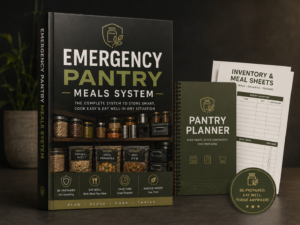
Emergency Pantry Meals System is a practical digital emergency pantry planning guide with 180+ shelf-stable meal ideas, 7-day, 14-day, and 30-day planning frameworks, storage and rotation guidance, budget pantry build paths, water planning notes, and household preparedness reference pages. This is a digital product delivered electronically. No physical product will be shipped.
 outdoor